
What a regular Yin twist practice actually does to you
Nov 04, 2026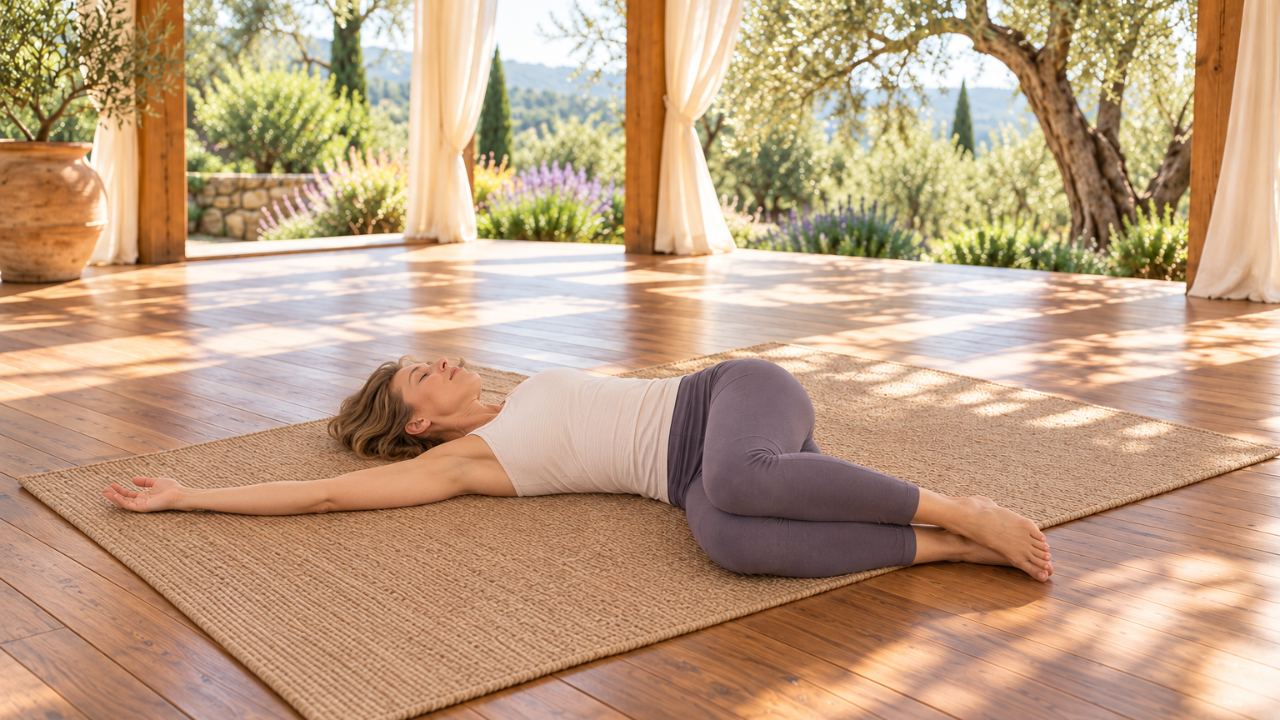
The shifts that happen slowly and why that’s exactly the point
Nobody tells you that the most significant changes from a Yin practice happen so slowly you almost miss them.
There’s no moment of dramatic breakthrough. No single session where everything shifts. Just a gradual, quiet recalibration and then one day you notice that something is different. That you’re moving through the world with a little more ease. That the things that used to grip you are gripping a little less.
I’ve been teaching Yin yoga for years, and this is the thing I find myself coming back to again and again with the women I work with. The practice works. But it works the way water works on stone consistently, over time, in ways you can’t always see until you look back.
Twists are where I see this most clearly.
What changes first
In the early weeks of a regular Yin twist practice, the first thing most women notice isn’t flexibility. It’s breath.
Specifically, the ability to breathe into the sides and back of the ribcage. The kind of breath that fills the whole torso rather than just lifting the chest. It sounds subtle. It isn’t. That quality of breath is a direct signal from the nervous system that something is releasing its grip.
The thoracic spine the mid and upper back is where we carry an enormous amount of accumulated tension. Desk posture, emotional bracing, the invisible weight of mental load. Long- held twists work directly into this area, into the connective tissue and the fascia that wraps around it, asking it, gently, repeatedly, to let go.
Fascia doesn’t release quickly. It can’t. It’s dense, slow-responding tissue. That’s why Yin holds each posture for three to five minutes, not to push through, but to give the tissue enough time to actually respond.
What changes next
After a few weeks, something else starts to shift. Women often describe it as feeling “lighter” and while that sounds vague, there’s real biology behind it.
The lymphatic system, your body’s immune and waste-clearance network, has no pump of its own. Unlike blood, which the heart drives around the body, lymph moves only through movement and breath. When we sit still for long periods, brace chronically, or simply stop moving the way the body needs, lymph stagnates. The body’s ability to clear and defend itself quietly diminishes.
The gentle abdominal compression of a twist, combined with the slow, expansive breath Yin invites, is one of the most effective ways to get lymph moving again. The organs shift. The fascia around them mobilises. The breath creates the pressure changes that encourage flow.
You’re not just stretching your spine. You’re waking up your immune system.
What changes over months
This is the part that’s harder to describe but easier to feel.
Over months of consistent practice, the body begins to trust the mat. Not in a conceptual way, in a cellular way. The nervous system learns that stillness is safe. That long holds aren’t a threat. That breath can move into places that have been held closed for years.
And as that trust builds, something else becomes available, a quality of presence that doesn’t require effort. A groundedness that travels with you off the mat. A relationship with your own body that feels less like management and more like conversation.
This is what I mean when I talk about Yin as a practice rather than a session. Any single class is valuable. But the cumulative effect of returning, week after week, to the same long holds, the same slow breath, the same patient attention, that is something else entirely.
Where to begin
If you’re new to Yin twists, start lying down. Supta Matsyendrasana, a simple supine spinal twist, is the most accessible entry point. Arms wide, knees drawn to one side, breath expanding into the back ribs. Three to five minutes per side. Nothing forced. Just presence and permission.
Let the exhale do the work. The body already knows what to release. It just needs the time and the conditions to do it.
Each month, the SUNPTUOUS™ Yinsights series releases a collectors card for the featured pose, hold time, body system, what it releases, and a note to take with you onto the mat.
November’s card is Twists. Download it, print it, keep it.
SUNPTUOUS™ MEMBERSHIP
The art of living well. Practised daily.
A full library of Yin yoga, somatic and energetic content. Live sessions and replays. A community of women who are living this work. And monthly direct access to me.
Everything you need for a consistent, well-held practice, in one place.

